There's something deeply satisfying about lying backward over a yoga block and letting your chest open. You breathe. You stretch. For a moment, you feel like you've undone every hour you've ever spent hunched over a laptop. But there's one small problem with treating chest-opening stretches as your entire posture routine.
Being able to move into extension doesn't automatically mean you've developed the strength to actively support it.
Catwoman Doesn't Just Bend Backward
Picture Catwoman moving across a rooftop. She's not holding one perfect position. She's reaching, rotating, extending and changing direction. Her body moves through different shapes. The impressive part isn't that she can get into those positions. It's that she can control them.
The flexibility to reach back is useful. The strength to actively manage your shoulders and upper back in that position is another skill.
Mobility gives you movement options. Strength helps you use them.
Meet Your Thoracic Spine
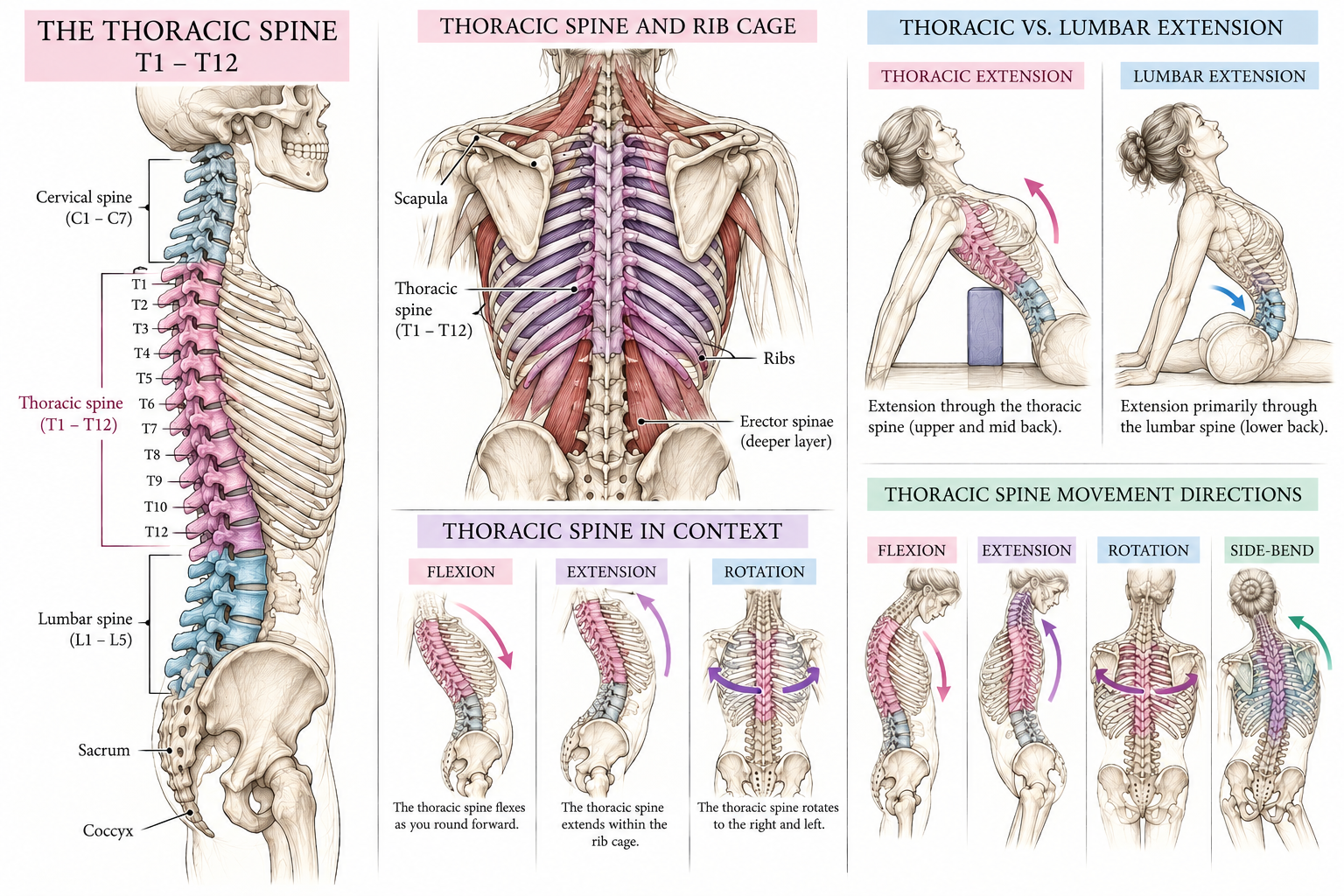
Your thoracic spine consists of 12 vertebrae, T1 through T12, and connects with your rib cage. Unlike your neck and lower back, the thoracic spine works within the structural demands of your ribs.
Your thoracic spine can flex, extend, rotate and side-bend. Those movements contribute to how you reach, twist, breathe and position your upper body. Because it sits between the neck and lower back, movement can sometimes become difficult to distinguish. Your lower back and neck do not house your organs- your ribs do. By design, your ribs rotate less than your low back or neck
You might think you're extending through your upper back when you're actually creating most of the movement through your lumbar spine.
Your Lower Back Doesn't Need to Do Everyone's Job
When we're working on thoracic extension, the goal isn't to create the biggest backbend possible. It's to explore extension through the upper and middle back. That's why supported extension over a yoga block can be useful. If you spent all day hunched over a phone or a steering wheel or a desk or any combo- this is a great wy to reverse those positions. The block provides a reference point. It gives you an opportunity to explore the movement … But eventually, we're going to remove that support.
And that's where the real work begins. Passively accessing a position and actively creating that position are different demands.
Eventually- we want to retrain the thoracic spine to rotate more efficiently- so the lower back is not doing all the rotation, and possibly being overused
Enter the Y, T and W
These exercises look easy. You're lying facedown. You lift your arms. Maybe your chest moves slightly.
How hard could it possibly be? The Y, T and W are commonly used to train muscles around the upper back, scapulae and posterior shoulders.
And despite their reputation as tiny little corrective exercises, they can be surprisingly challenging when performed slowly and deliberately.
The Y
Your arms reach diagonally overhead, creating a Y shape.
This position challenges the muscles that help position and control your scapulae, including portions of the trapezius.
The T
Your arms extend outward to the sides.
Now you're challenging shoulder horizontal abduction and scapular control in a different position.
The W
Your elbows bend, bringing your arms into a W shape.
This variation emphasizes control around the shoulder blades and posterior shoulder, with external rotation playing a role depending on how the exercise is performed.
Each position changes the demands on your shoulder complex. And none requires you to aggressively jam your shoulder blades together.
Small Movements. Big Opinions.
Pilates exposes how much work can happen without huge movement. You don't need a giant backbend. You don't need heavy weights. You need deliberate movement, appropriate effort and control If your neck is doing all the work while your shoulders are trying to climb into your ears, you cant wonder why your traps look bulky and your shoulder feel tight. The same goes for prone thoracic extension. We're asking the muscles of the upper back to create and manage bending in all directions
Controlled movement beats dramatic movement.
Unless we're talking about your entrance to a party. Then dramatic is encouraged.
Why We Combine Extension and Strength
Supported thoracic extension: Explore spinal movement with support.
Prone extension: Actively produce movement against gravity
Y/T/W exercises: Challenge muscles around the scapulae and shoulders
External rotation: Add another layer of shoulder control.
Controlled swimmer variations: Bring these skills together.
A sequence that moves from supported mobility into active work.
We're getting you to access a position. Then control all movements your joints can do in it
Your Upper Back Doesn't Need to Be Perfect
Your thoracic spine has a natural curve. That curve is called kyphosis.
Your spine is not supposed to be a perfectly straight rod. Different people have different spinal shapes and movement capacities. The goal of this workout is not to erase the natural curvature of your upper back.
Let’s explore extension and build strength and endurance through a range of positions, which imho is what functional really means
Train It: Pretty Girl Posture Part 3
In Pretty Girl Posture Part 3: Thoracic Extension + Y/T/W, we're combining supported mobility with active upper-back training.
This 15-minute workout uses a yoga block.
We begin with supported thoracic extension and chest opening.
Then into controlled upper-back movement, shoulder strength and muscular endurance.
Coming Next: We've trained shoulder movement. We've added upper-back strength. We've explored thoracic extension.
In Part 4, we're talking about what Pilates actually means by rib-cage and core control.
Because some of you just have ribs.
NEXT: YOUR RIBS MIGHT NOT NEED FIXING
